Finalist-PhilBlogAwards 2010

Finalist-PhilBlogAwards 2010
Finalist for society, politics, history blogs

BrightWorld

Pages

Showing posts with label Vietnam. Show all posts

Monday, March 05, 2012

INDUSTRIAL COMPETITIVENESS IN VIETNAM

INDUSTRIAL COMPETITIVENESS IN VIETNAM

Erle Frayne D. Argonza

Industrialization is the crux of Vietnam’s development agenda. This is the signal being beaconed by the first industrial competitiveness report of the same country.

Among the high-growth economies of East Asia, Vietnam’s growth has been truly remarkable. Vietnam’s policy makers have hinged their growth goals on physical economy frameworks as a way to growth and income redistribution, rendering it as a model for social markets that began their development trajectories from old mode socialism.

There is no reason that Cambodia and Laos shouldn’t follow the footsteps of Vietnam. May I add Nepal which, for some time after the overthrow of the ancien regime of monarchy there, has been governed by popularly elected socialist parties.

Below is an update report on the report from the UNIDO media center.

[Philippines, 29 February 2012]

Source: http://www.unido.org/index.php?id=7881&tx_ttnews[tt_news]=992&cHash=6c50fb11e63729562523cbb35b2b91e6

Viet Nam’s first Industrial Competitiveness Report launched

HANOI, 13 December 2011 - The United Nations Industrial Development Organization (UNIDO) and the Ministry of Industry and Trade today launched the 2011 Viet Nam Industrial Competitiveness Report.

The report will contribute to the existing policy debate in Viet Nam by providing a conceptual framework for understanding the drivers of industrial competitiveness, positioning Vietnamese industries in the international context, identifying industrial bottlenecks that can be addressed by policy, and presenting specific recommendations for the leaders of the country.

The report makes the case that industrialization is at the core of Viet Nam’s economic growth. This is in line with empirical and historical evidence which shows that a fast-growing economy needs a vibrant industrial sector. Boosting the manufacturing sector is likely to be even more important in the future if Viet Nam is to create more wealth and employment.

The report argues that structural change towards certain strategic technology intensive sectors can speed up the industrialization process, thus providing the right conditions for sustained growth.

The Deputy Minister of Industry and Trade, Le Duong Quang, said that “the 2011 Viet Nam Industrial Competitiveness Report will be deemed a useful document which supports policymakers in the formulation of industrial and trade policies that meet the requirements of the realities of the new stage in Viet Nam’s industrial development”.

He emphasized two major issues of concern highlighted in the report: the evaluation of the role of trade liberalization in recent years for economic and productive restructuring, and the need for a re-formulation of industrial policy and strategies to take account of national priorities, as well as of global threats and opportunities. The release of the report is timely as it raises important policy implications, said Le Duong Quang.

UNIDO Managing Director, Wilfried Luetkenhorst, pointed out that “industrial competitiveness is not – or at least not entirely – determined solely by a country’s factor endowment. Competitive advantages can be created”. He added that the report advocated this idea by arguing that Viet Nam needed to move up into technologically more sophisticated and higher value added activities.

The 2011 Viet Nam Industrial Competitiveness Report is a collaborative product between the Ministry of Industry and Trade and UNIDO in the context of the One UN funded programme “Building National Capacity in Industrial Diagnosis and Trade Competitiveness Analysis”.

The report was prepared by UNIDO staff and the Industrial Competitiveness Group, an inter-ministerial working group consisting of young professionals trained by UNIDO. It also benefited from the inputs and supervision of an Advisory Board composed of high-level senior government officials and advisors.

For further information, please contact:

Patrick Gilabert
UNIDO Representative
Viet Nam Country Office
Tel: +844-38 22 44 90

Tuesday, February 21, 2012

CAN SMART FARMING REVERSE CLIMATE CHANGE IMPACT?

CAN SMART FARMING REVERSE CLIMATE CHANGE IMPACT?

Erle Frayne D. Argonza

Can smart farming equalize or even totally reverse the deleterious impact of climate change? What parameters and factors (soil? seeds? water? skills? technology?) need to have some control altogether to see the positive effects of the interventions?

That question is the subject of intense response today by stakeholders in Malawi, Vietnam and Zambia that have embarked on smart farming pilot works. FAO and the European Commission have bankrolled the pilot projects.

It may take at least three (3) years of experimentations and observations before the projects can bear fruit. Smart farming is no new concept actually, as the International Rice Research Institute or IRRI had already introduced similar interventions—applied to rice production—since its launching in 1964 yet.

Let’s see what will happen to these pilot projects.

[Philippines, 08 February 2012]

Source: http://www.fao.org/news/story/en/item/119835/icode/

FAO-EC project to promote climate-smart farming

16 January 2012, Rome - FAO and the European Commission announced today a new €5.3 million project aimed at helping Malawi, Vietnam and Zambia transition to a "climate-smart" approach to agriculture.

Agriculture — and the communities who depend on it for their livelihoods and food security — are highly vulnerable to climate change impacts. At the same time agriculture, as a significant producer of greenhouse gases, contributes to global warming.

"Climate-smart agriculture" is an approach that seeks to position the agricultural sector as a solution to these major challenges.

It involves making changes in farming systems that achieve multiple goals: improving their contribution to the fight against hunger and poverty; rendering them more resilient to climate change; reducing emissions; and increasing agriculture's potential to capture and sequester atmospheric carbon.

"We need to start putting climate-smart agriculture into practice, working closely with farmers and their communities," said FAO Assistant Director-General for the Economic and Social Development Department, Hafez Ghanem. "But there are no one-size-fits-all solutions — better climate-smart farming practices need to respond to different local conditions, to geography, weather and the natural resource base," he added.

"This project will look closely at three countries and identify challenges and opportunities for climate-smart agriculture and produce strategic plans tailored to each country's own reality," Ghanem said. "While not all solutions identified will be universally applicable, we can learn a lot about how countries could take similar steps and begin shifting to this approach to agriculture."

Tailor-made solutions

The EU is providing €3.3 million to support the effort; FAO's contribution is €2 million.

Working closely with agriculture and other ministries in each of the partner countries, and collaborating with local and international organizations, the three-year project will:

  • Identify country-specific opportunities for expansion of existing climate-smart practices or implementation of new ones
  • Study the constraints that need to be overcome to promote wider adoption of climate-smart agriculture, including investment costs
  • Promote integration of national climate change and agricultural strategies to support the implementation of climate-smart agriculture
  • Identify innovative mechanisms for linking climate finance with climate-smart agriculture investments
  • Build capacity for planning and implementing climate-smart projects capable of attracting international investments


FAO will take the overall lead on the project, working in partnership with national policy and research institutions, as well as global organizations such as the Global Crop Diversity Trust.

By tackling the urgent need to incorporate climate change concerns into agricultural development planning, this new project represents a concrete step forward, said Ghanem. "The problems of climate change are increasingly being felt on the ground, and thus early actions to address the problem are needed, even as international negotiations continue in the search for a global climate agreement," he said.

Sunday, October 09, 2011

CAMBODIA EX-REFUGEES WIN CITIZENSHIP, HOME OWNERSHIP FOLLOWS

CAMBODIA EX-REFUGEES WIN CITIZENSHIP, HOME OWNERSHIP FOLLOWS

Erle Frayne D. Argonza

The saga of Cambodians fleeing their own country is among the epical dramas of modern-day international migration. They are tales that befit narratives worth presenting in the global theatrical scene, such as Ms Saigon was for Vietnam’s war epic.

Hundreds of thousands of Cambodians fled their country at the peak of the war with America. The migration problem was compounded further by the Khmer Rouge genocide campaign against urban habitués, of which possibly 2 million lives were terminated in the pogrom. Hundreds of thousands again fled Cambodia, with so many of them moving to Vietnam.

As to those Cambodians who decided never to return, on account of the traumas that seemed to refuse healing, the human interest stories can come straight from those who settled in Hanoi or Saigon. Below is a fitting narrative of such resettled Cambodians who are elated over their gaining citizenship in their host countries.

[Philippines, 09 October 2011]

Source: http://www.unhcr.org/4e7204db6.html

Statelessness: Former refugees win citizenship, and now dream of home ownership

News Stories, 15 September 2011

© UNHCR/K. McKinsey

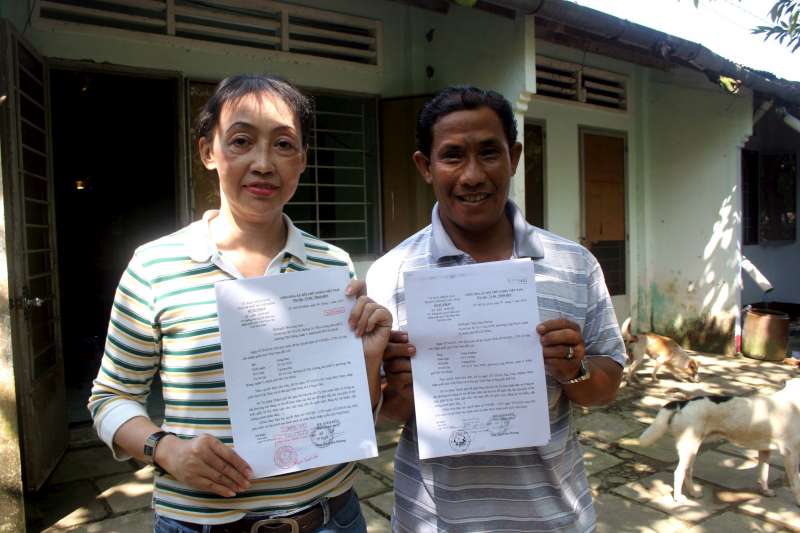
Nguyen The Tai (right) and his sister Le Ngoc Hai outside their mother's house near Viet Nam's Ho Chi Minh City. The ex-refugees from Cambodia were stateless until they received Vietnamese citizenship last year.

HO CHI MINH CITY, Viet Nam, September 15 (UNHCR) – When the coconut groves of this city's Thu Duc district became a refugee camp nearly 30 years ago, the area was so remote it was a five-hour commute from the centre – by rowboat.

Now called District Nine, today it's one of the most fashionable areas of the booming southern metropolis of Ho Chi Minh City (formerly Saigon), where wealthy business people build villas and fanciful walled castles, which they reach in less than an hour over bridges and wide highways.

Luxury property has always been out of the reach of Nguyen The Tai, who fled Cambodia and came here as a refugee when he was just 11, and has been stateless all his life. In fact, he never even dreamed of buying the small cinder-block row house built by UNHCR where he lives with his 75-year-old mother.

But his dreams expanded exponentially after he finally got Vietnamese citizenship last year, along with some 2,300 other former stateless Cambodians. Thanks to UNHCR's efforts, he now has a chance to buy his rented house from the local authorities at just two per cent of the market price.

"I would be very happy to be the owner of this house," the cheerful 46-year-old says, romping with his dog in his small garden. "In Vietnamese there is a proverb, 'settlement before career'."

Not that he's had much of a career either. Because he was stateless, Tai – he took the Vietnamese name when he got his citizenship – could only work as an unskilled labourer at perhaps half the going rate, despite being a skilled electrician. He could not get bonded, obtain an identity card, or legally marry his common-law wife of nine years.

His older sister, now called Le Ngoc Hai, has also paid a life-long price for their statelessness, lingering fall-out from the Pol Pot years in Cambodia. The family fled in 1975 after their father, a former Cambodian military officer, was attacked with an axe by Pol Pot's murderous Khmer Rouge. He died of his injuries after reaching Viet Nam.

Despite speaking fluent French, the closest Hai has come to using it professionally was while working as an underpaid cook for a Frenchman in Ho Chi Minh City for the last 15 years.

In the 1980s, as they saw thousands of other refugees resettled abroad, the family originally hoped they would get to join relatives in France. A change in policies shattered that dream, and by the mid-1990s, their focus shifted to trying to get citizenship in their adopted home, where they had learned the language and customs. But they were caught in a legal limbo, because Viet Nam required them to relinquish their Cambodian citizenship, and Cambodia had renounced them.

The aspirations of all the stateless refugees in this settlement plummeted. "I just had one simple hope: that when I died I could get a death certificate, to prove that I ever existed," said one of the family's neighbours in the row of modest townhouses built by UNHCR and later handed over to municipal authorities.

Hai, the mother of two teenagers, feels a tinge of sadness she had to wait 35 years to become a citizen, but she and her brother are still optimistic about the future.

"I am not very young, but I am not very old," the 51-year-old says, "so I can still hope my life can change because of my new nationality."

Her brother adds with a smile: "Physically I am strong, stronger than young people, so now I hope I can work in my real profession." And buy that house, of course.

By Kitty McKinsey

In District Nine, Ho Chi Minh City, Viet Nam

@@@@@@@@@@@@@@@@@@@@@@@@@@@@@@@

http://erleargonza.blogspot.com, http://unladtau.wordpress.com, http://www.facebook.com, http://www.newciv.org, http://sta.rtup.biz, http://magicalsecretgarden.socialparadox.com, http://en.netlog.com/erlefrayne, http://www.blogster.com/erleargonza, http://www.articlesforfree.net, http://ipeace.us, http://internationalpeaceandconflict.org, http://www.blogleaf.com/erleargonza, http://erleargonza.seekopia.com, http://lovingenergies.spruz.com, http://multiply.com/erleargonza, http://www.blogleaf.com/erleargonza, http://talangguro.blogfree.net

Thursday, September 15, 2011

VIETNAM SCIENCE UNIVERSITY LEADS TERTIARY EDUCATION REFORMS

VIETNAM SCIENCE UNIVERSITY LEADS TERTIARY EDUCATION REFORMS

Erle Frayne D. Argonza

The legacy of tertiary level education left by the French empire to Vietnam may not have been auspicious enough. Universities in the country tended to be over-centralized and filled with politics.

The coming to power of the socialists reinforced the clientelist politics within universities. Such a politics and over-centralization retarded the growth of universities as a whole, disabling them from responding to the professional and expertise needs of a growing economy.

To address the problem, a science and technology university is now being installed in Hanoi. France and the Asian Development Bank have collaborated to partly fund the ambitious project university which will open in six (6) years’ time.

The update report on education reforms is shown below.

[Philippines, 15 September 2011]

Source: http://www.scidev.net/en/news/vietnam-s-new-science-university-marks-start-of-reforms-.html

Vietnam's new science university 'marks start of reforms'

Mike Ives

19 August 2011 Hanoi man on bicycle

[HANOI] A science and technology university under construction in Vietnam will promote a new model of higher education in the country, according to the Asian Development Bank (ADB).

The 5,000-student University of Science and Technology of Hanoi — to be completed within five or six years at a cost of US$213 million — will encourage stronger links between teaching and research, and promote collaborations with the private sector, said Norman LaRocque, senior education specialist at the ADB, which has lent US$190 million for construction.

France has donated about US$140 million to the university for development and operating costs over the next ten years.

Although smaller than other public universities in Asia, the university represents "a new model in the sense of having a much more autonomous and rigorous governance structure than virtually all of the other universities in Vietnam," LaRocque told SciDev.Net. The curricula of Vietnamese universities are heavily influenced by central government planning, he said.

The university, which opened at a temporary location last October and is enrolling students, is part of a "bottom-up process of reform", said LaRocque, adding that Vietnam's higher education system is "overly centralised and highly politicised".

Vietnamese universities typically cannot produce useful or timely research for industry, he said, and Vietnamese professors lag behind their counterparts from more developed South-East Asian countries in terms of academic productivity. In 2005, Vietnamese researchers produced about 2.5 peer-reviewed science and engineering articles per million people — roughly half that produced by researchers in Thailand, for example.

Phan Hong Son, executive director of Vietnam's National Foundation for Science and Technology Development, acknowledged shortcomings in Vietnam's university system but said the country is "pushing very hard" to improve educational standards.

The new university will "enhance the quality of higher education in Vietnam", Son said, adding that it will help to ease mounting enrolment pressures associated with Vietnam's largely young population.

A new generation of Vietnamese students is earning PhDs abroad and will eventually return to teach at the university, he said, but in the meantime, French professors will provide teaching and training.

Son welcomed the French involvement but said the new university may have trouble recruiting enough Vietnamese students who can follow technical lectures in English and French.

Son and LaRocque agreed that the university's biggest challenge will be maintaining long-term support from the Vietnamese authorities.

"Ribbon cutting is really sexy, but it's not so sexy to make sure you have enough money to keep the lights on, fix equipment and pay staff," said LaRocque.

@@@@@@@@@@@@@@@@@@@@@@@@@@@@@@@@@@@@

Come Visit E. Argonza’s blogs & website anytime!

Social Blogs:

IKONOKLAST: http://erleargonza.blogspot.com

UNLADTAU: http://unladtau.wordpress.com

Wisdom/Spiritual Blogs:

COSMICBUHAY: http://cosmicbuhay.blogspot.com

BRIGHTWORLD: http://erlefraynebrightworld.wordpress.com

Poetry & Art Blogs:

ARTBLOG: http://erleargonza.wordpress.com

ARGONZAPOEM: http://argonzapoem.blogspot.com

Mixed Blends Blogs:

@MULTIPLY: http://efdargon.multiply.com

@SOULCAST: http://www.soulcast.com/efdargon

Website:

PROF. ERLE FRAYNE ARGONZA: http://erleargonza.com

Saturday, November 06, 2010

$100B MEKONG INTEGRATED PROJECT TO BOOST ASEAN POTENCY

Erle Frayne Argonza y Delago


Magandang araw! Good day!

Around two (2) years ago, I articulated in one article the gigantic project that will rise in the Mekong River very soon. I was at that time already very supportive of the project, a support that I will re-echo at this moment.

For those unfamiliar with the project, a plan was hatched at the middle part of the decade for an integrated project along the Mekong River. Since the river begins upstream at the China side, China logically has to be involved in it. Finally, with blueprints for implementation on the go around 2007 yet, China committed to fund the projected cost of $100 Billion.

So huge a project, it will have couples of components into it. Power generation, irrigation, flood control, transportation, and tourism comprise the core sector components. A project of that size is four (4) times bigger than China’s own 3-Gorges Dam (it cost $23 at 2000 price index) and could be the largest that the world will ever have experienced once fully accomplished.

Benefiting approximately 300 million beneficiaries along its courses, the project is bound to spur development and generate incomes many folds larger than its total investments. If we use the econometric index of annual income yield that is 10X, then we can expect an annual income yield of $1 Trillion from out of the upstream and downstream industries induced by the project.

Since China is involved in it right now (as implementation is going on), then we expect China to receive the ROI (return on investments) in the widest expanse of benefits possible. That means, once fully operational, China will infuse more investments in the region to fully benefit from the project alone. The ROI will then be much greater than the original $100 accruing to China alone on an annual basis.

We can therefore hope for an excellent win/win situation for China and the ASEAN countries involved (Vietnam is the lead country executor). In the long run, we should hope that the same project would accrue to the growth & development of the entire ASEAN region that is bound to institute an economic union by 2015.

A win/win formula for the ASEAN itself is for it to use the Mekong project as exemplar to design and implement similar projects in other member countries, particularly in island southeast Asia. A particular office can be created in the ASEAN secretariat to oversee and help similar projects that can spin off in other parts of the region.

Since an ASEAN central bank is due for institution by 2015, let us expect that monetary instruments for financial packages can be had for gigantic infrastructure projects of the magnitude of the Mekong project. Probably an ASEAN Development Bank can also rise alongside the central bank, thus reinforcing the potency for launching gigantic projects that will be financed internally by the region itself.

If ever the ASEAN will wish to tap other countries for co-financing of the projects, it should be the emerging markets as top priority such as China, India, and Brazil, countries that will be more sympathetic to regional development. The option will help us veer away from the mal-intents of Northern banks that tied up developing countries in debt peonage and won at the expense of the developing countries.

As a matter of goodwill, ASEAN should better enter into the picture and look at other facets of the project that the future union can fund. The expansion phases of the Mekong project, for instance, can be taken over by the ASEAN itself, thus lessening dependence from external funders.

There are always pains to any large project, these being part of the costs of any undertaking. Nonetheless, the Mekong project should be supported and must go on until full completion. This will render it as an exemplar just right in time for the creation of the ASEAN economic union by 2015.

[Philippines, 05 November 2010]


[See: IKONOKLAST: http://erleargonza.blogspot.com,
UNLADTAU: http://unladtau.wordpress.com,
COSMICBUHAY: http://cosmicbuhay.blogspot.com,
BRIGHTWORLD: http://erlefraynebrightworld.wordpress.com, ARTBLOG: http://erleargonza.wordpress.com,
ARGONZAPOEM: http://argonzapoem.blogspot.com]