Finalist-PhilBlogAwards 2010

Finalist-PhilBlogAwards 2010
Finalist for society, politics, history blogs

BrightWorld

Pages

Showing posts with label housing. Show all posts

Monday, October 10, 2011

IMPROVING SHELTERS FOR CHILD VICTIMS OF HUMAN TRAFFICK: DOMINICAN REPUBLIC SHOWCASE

IMPROVING SHELTERS FOR CHILD VICTIMS OF HUMAN TRAFFICK: DOMINICAN REPUBLIC SHOWCASE

Erle Frayne D. Argonza

Governance reforms in the Dominican Republic have included strengthening institutional capacity to deal with problems of children and adolescents. The country’s National Council for Children and Adolescents (CONANI) is the lead agency created for the task.

The CONANI had so far been operating on an expanded mandate so as to cover problems related to human traffick. In this regard, the International Organization for Migration or IOM has been co-partnering with the CONANI’s efforts, with commitments going up through the sheltering of child victims of human traffick.

Below is an update report about the subject that makes the country a showcase in sheltering affected children.

[Philippines, 11 October 2011]

Source: http://www.iom.int/jahia/Jahia/media/press-briefing-notes/pbnAM/cache/offonce/lang/en?entryId=30589

Improving Shelters for Child Victims of Trafficking in the Dominican Republic

Posted on Friday, 16-09-2011

Dominican Republic - This week IOM completed its Children's Shelter Improvement Plan in coordination with the Dominican National Council for Children and Adolescents (CONANI) as part of its programme to build the capacity of the Dominican authorities to manage cases of child victims of trafficking.

Four temporary shelters managed by CONANI have received structural improvements and material necessities in order to improve the conditions of vulnerable children in need of protection, including Dominican children, unaccompanied minor migrants and victims of trafficking, under the care of the Dominican child protection authorities.

Structural improvements to the physical structures of the four shelters included replacing broken doors and windows, painting walls, building walls to increase privacy, and paving outdoor patio play-spaces.

Based on the needs of each facility, IOM has furnished the shelters with games, books, and other educational materials, as well as a range of appliances including fans, water coolers, washing machines, lockers, and lawn mowers.

"IOM works closely with CONANI in the search for durable solutions for child victims of trafficking and unaccompanied minor migrants. Improvements to these shelters will help CONANI to provide enhanced care to child victims of trafficking that end up in the protection of the State. Other vulnerable children found in these facilities will also benefit," explains Cy Winter, IOM Chief of Mission in Santo Domingo.

These physical and material improvements have been carried out in conjunction with a series of trainings for the staff of five of CONANI's temporary shelters on how to identify signs that a child has been a victim of human trafficking, as well as how to provide specialized attention to child victims. The staff training complements an awareness campaign carried out with more than 300 members of the child protection system via 11 workshops held in late 2010.

Since the January 2010 earthquake in Haiti, IOM has also formed part of the inter-agency CONANI Technical Assistance Committee seeking solutions for the unaccompanied minors under CONANI protection as a result of being displaced by the earthquake.

There are currently 234 children in the care of CONANI's temporary shelters; 45 are Haitian nationals.

In 2011 IOM has worked with the child protection authorities in the Dominican Republic and CONANI and with Haiti's Institute for Social Well-Being and Research (IBESR) to provide family tracing, return and reintegration assistance to 23 Haitian child victims of trafficking, including a large group of children trafficked for forced begging rescued by the Dominican General Directorate of Migration in a February 2011 raid.

As part of IOM's continued cooperation with the child protection authorities in both countries, IOM organized a bi-national meeting in May 2011 aimed at improving dialogue on short-term care and long-term solutions for unaccompanied minor migrants and child victims of trafficking. A follow up visit by staff of IBESR to CONANI is planned for October.

IOM's work to improve the conditions of child migrants and child victims of trafficking in the Dominican Republic is made possible through support from the United States Department of State, Bureau of Population, Refugees and Migration (PRM) and the Office to Monitor and Combat Trafficking in Persons (GTIP), and the United Kingdom Foreign and Commonwealth Office in Santo Domingo.

For more information, please contact:

Gina Gallardo
E-mail: ggallardo@iom.int

or

Zoë Stopak-Behr
IOM Santo Domingo
Tel: 809 688 8174
E-mail: zstopak-behr@iom.int

@@@@@@@@@@@@@@@@@@@@@@@@@@@@@@@

http://erleargonza.blogspot.com, http://unladtau.wordpress.com, http://www.facebook.com, http://www.newciv.org, http://sta.rtup.biz, http://magicalsecretgarden.socialparadox.com, http://en.netlog.com/erlefrayne, http://www.blogster.com/erleargonza, http://www.articlesforfree.net, http://ipeace.us, http://internationalpeaceandconflict.org, http://www.blogleaf.com/erleargonza, http://erleargonza.seekopia.com, http://lovingenergies.spruz.com, http://multiply.com/erleargonza, http://www.blogleaf.com/erleargonza, http://talangguro.blogfree.net

Sunday, October 09, 2011

CAMBODIA EX-REFUGEES WIN CITIZENSHIP, HOME OWNERSHIP FOLLOWS

CAMBODIA EX-REFUGEES WIN CITIZENSHIP, HOME OWNERSHIP FOLLOWS

Erle Frayne D. Argonza

The saga of Cambodians fleeing their own country is among the epical dramas of modern-day international migration. They are tales that befit narratives worth presenting in the global theatrical scene, such as Ms Saigon was for Vietnam’s war epic.

Hundreds of thousands of Cambodians fled their country at the peak of the war with America. The migration problem was compounded further by the Khmer Rouge genocide campaign against urban habitués, of which possibly 2 million lives were terminated in the pogrom. Hundreds of thousands again fled Cambodia, with so many of them moving to Vietnam.

As to those Cambodians who decided never to return, on account of the traumas that seemed to refuse healing, the human interest stories can come straight from those who settled in Hanoi or Saigon. Below is a fitting narrative of such resettled Cambodians who are elated over their gaining citizenship in their host countries.

[Philippines, 09 October 2011]

Source: http://www.unhcr.org/4e7204db6.html

Statelessness: Former refugees win citizenship, and now dream of home ownership

News Stories, 15 September 2011

© UNHCR/K. McKinsey

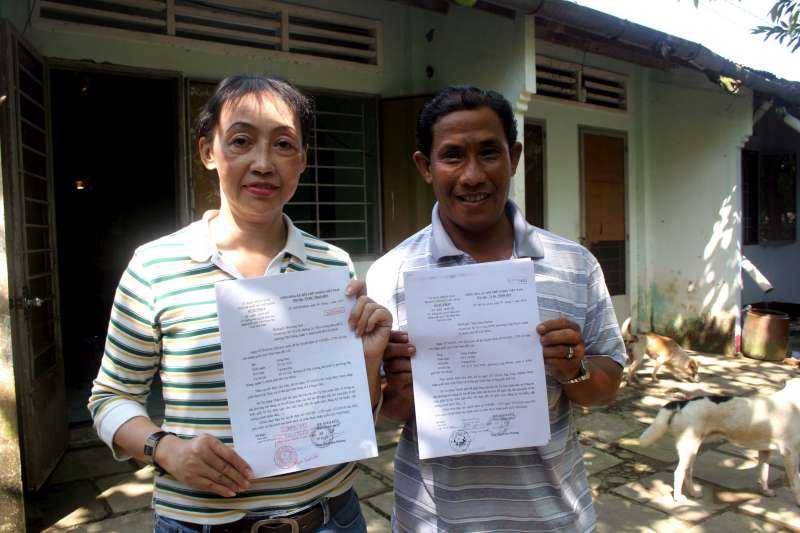
Nguyen The Tai (right) and his sister Le Ngoc Hai outside their mother's house near Viet Nam's Ho Chi Minh City. The ex-refugees from Cambodia were stateless until they received Vietnamese citizenship last year.

HO CHI MINH CITY, Viet Nam, September 15 (UNHCR) When the coconut groves of this city's Thu Duc district became a refugee camp nearly 30 years ago, the area was so remote it was a five-hour commute from the centre by rowboat.

Now called District Nine, today it's one of the most fashionable areas of the booming southern metropolis of Ho Chi Minh City (formerly Saigon), where wealthy business people build villas and fanciful walled castles, which they reach in less than an hour over bridges and wide highways.

Luxury property has always been out of the reach of Nguyen The Tai, who fled Cambodia and came here as a refugee when he was just 11, and has been stateless all his life. In fact, he never even dreamed of buying the small cinder-block row house built by UNHCR where he lives with his 75-year-old mother.

But his dreams expanded exponentially after he finally got Vietnamese citizenship last year, along with some 2,300 other former stateless Cambodians. Thanks to UNHCR's efforts, he now has a chance to buy his rented house from the local authorities at just two per cent of the market price.

"I would be very happy to be the owner of this house," the cheerful 46-year-old says, romping with his dog in his small garden. "In Vietnamese there is a proverb, 'settlement before career'."

Not that he's had much of a career either. Because he was stateless, Tai he took the Vietnamese name when he got his citizenship could only work as an unskilled labourer at perhaps half the going rate, despite being a skilled electrician. He could not get bonded, obtain an identity card, or legally marry his common-law wife of nine years.

His older sister, now called Le Ngoc Hai, has also paid a life-long price for their statelessness, lingering fall-out from the Pol Pot years in Cambodia. The family fled in 1975 after their father, a former Cambodian military officer, was attacked with an axe by Pol Pot's murderous Khmer Rouge. He died of his injuries after reaching Viet Nam.

Despite speaking fluent French, the closest Hai has come to using it professionally was while working as an underpaid cook for a Frenchman in Ho Chi Minh City for the last 15 years.

In the 1980s, as they saw thousands of other refugees resettled abroad, the family originally hoped they would get to join relatives in France. A change in policies shattered that dream, and by the mid-1990s, their focus shifted to trying to get citizenship in their adopted home, where they had learned the language and customs. But they were caught in a legal limbo, because Viet Nam required them to relinquish their Cambodian citizenship, and Cambodia had renounced them.

The aspirations of all the stateless refugees in this settlement plummeted. "I just had one simple hope: that when I died I could get a death certificate, to prove that I ever existed," said one of the family's neighbours in the row of modest townhouses built by UNHCR and later handed over to municipal authorities.

Hai, the mother of two teenagers, feels a tinge of sadness she had to wait 35 years to become a citizen, but she and her brother are still optimistic about the future.

"I am not very young, but I am not very old," the 51-year-old says, "so I can still hope my life can change because of my new nationality."

Her brother adds with a smile: "Physically I am strong, stronger than young people, so now I hope I can work in my real profession." And buy that house, of course.

By Kitty McKinsey

In District Nine, Ho Chi Minh City, Viet Nam

@@@@@@@@@@@@@@@@@@@@@@@@@@@@@@@

http://erleargonza.blogspot.com, http://unladtau.wordpress.com, http://www.facebook.com, http://www.newciv.org, http://sta.rtup.biz, http://magicalsecretgarden.socialparadox.com, http://en.netlog.com/erlefrayne, http://www.blogster.com/erleargonza, http://www.articlesforfree.net, http://ipeace.us, http://internationalpeaceandconflict.org, http://www.blogleaf.com/erleargonza, http://erleargonza.seekopia.com, http://lovingenergies.spruz.com, http://multiply.com/erleargonza, http://www.blogleaf.com/erleargonza, http://talangguro.blogfree.net